



Attribution is no exact science, it’s a game of perspective.
There is no 1 model that will tell you with 100% accuracy which touchpoint drove which order. And no objective attribution platform can see as much in-depth what people are doing on the ad platforms, as the ad platforms themselves. Anyone that says otherwise, is lying to you. But at the same there are some major flaws in the ad platform attribution; they are biased towards only themselves and they do not account for any profitabiliy behind ROAS.
So a good objective attribution platform helps you fill in those information gaps, by running a nuanced model built on actual sales data, all sessions and all impressions. And by showing you the margin, first time customer rate and return rates of an attributed order set.
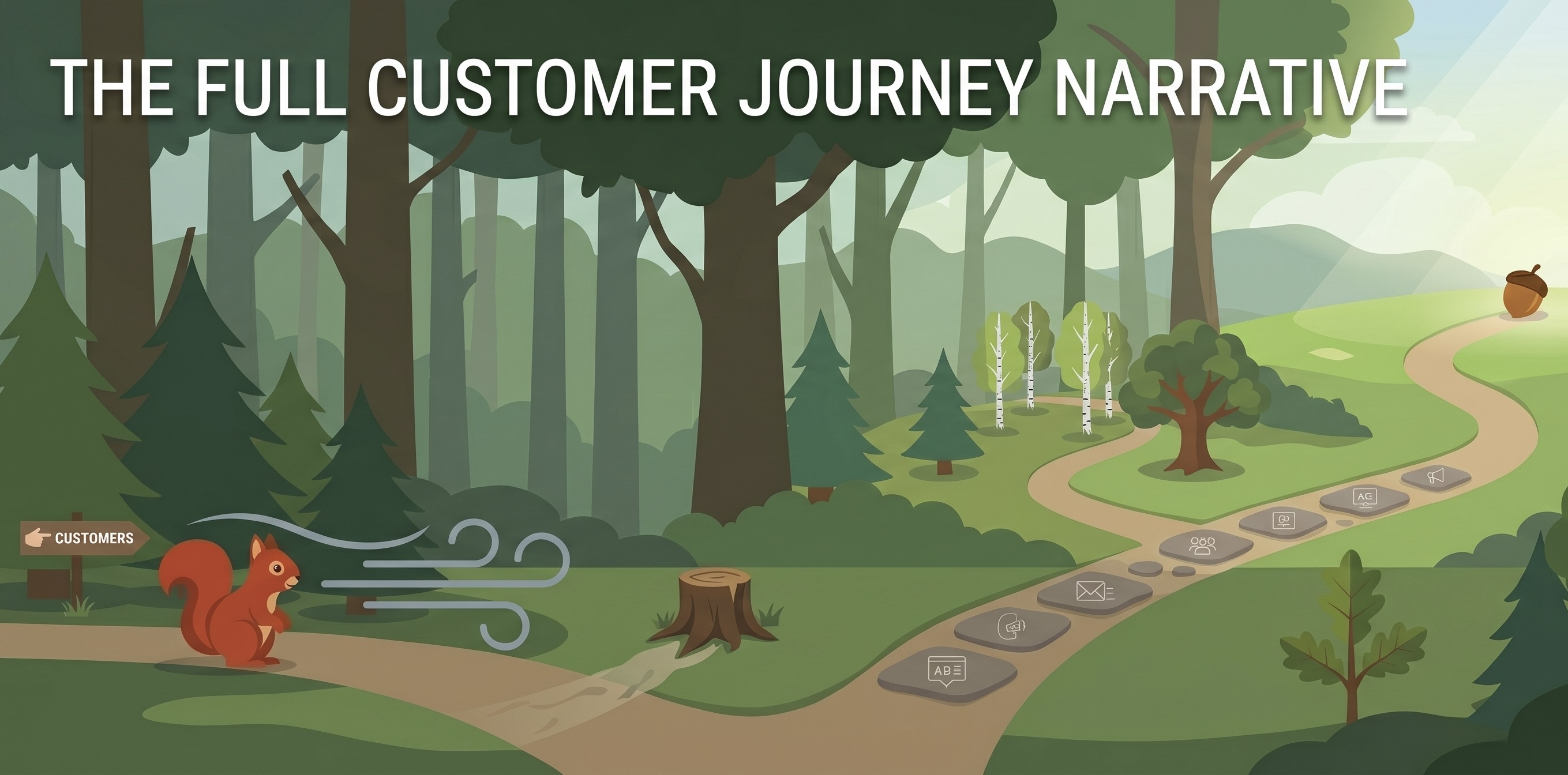
In this article, we help you understand how the Eyk data-driven + views attribution model builds up a unique perspective on your customer journey, by using the fitting analogy of a squirrel planting acorns in a forest.
Picture a squirrel. She's hungry, and she's on the hunt for the perfect acorn. Not just any acorn, but one worth planting. One that might grow into a tree and produce hundreds more. She doesn't rush. She sniffs around. She scurries from clearing to clearing, checks on spots she's visited before, doubles back, gets distracted, comes back again. And eventually, she digs a hole and plants her acorn.
That squirrel is your customer. The planted acorn, a conversion.
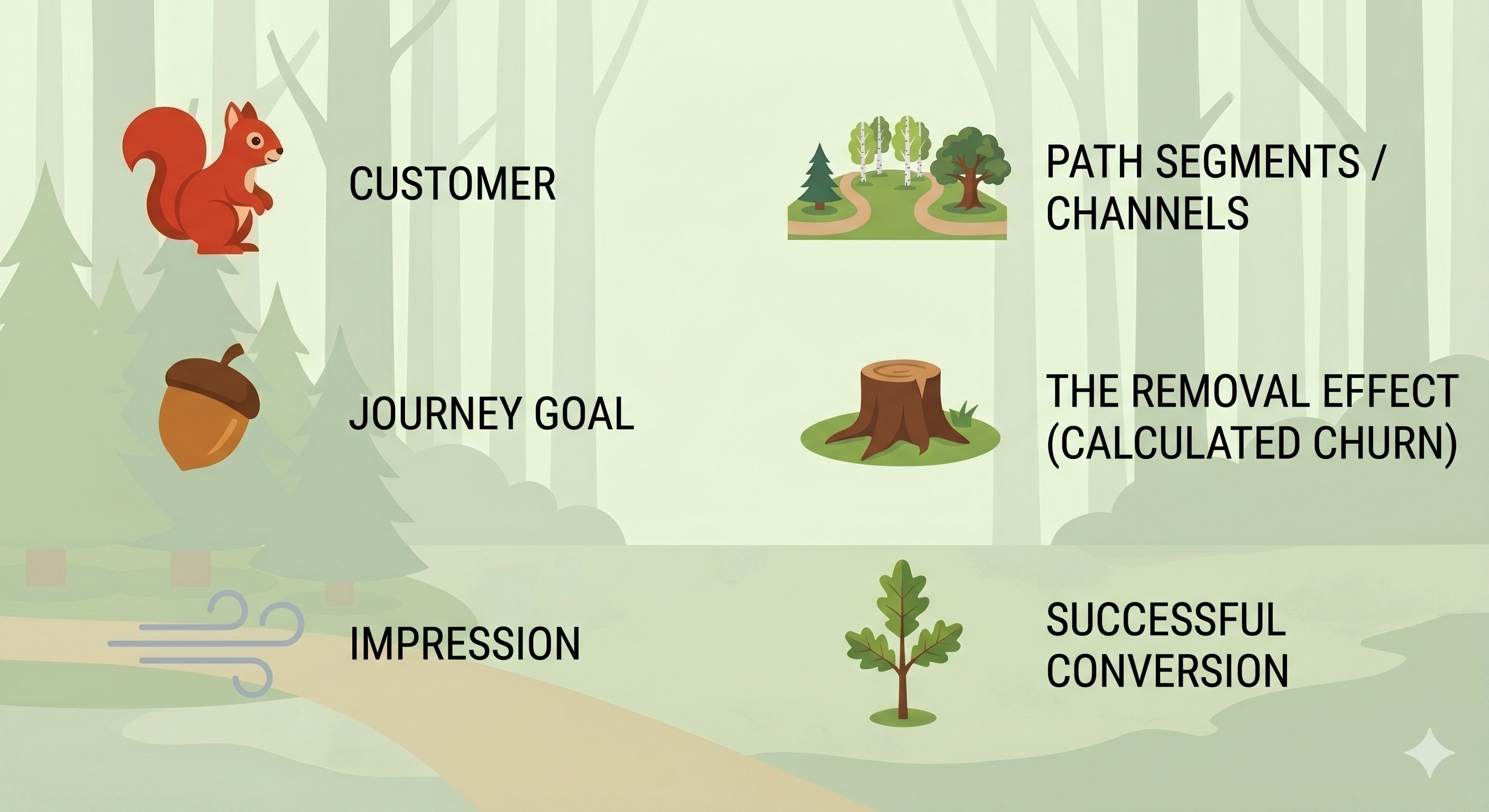
Every customer moves through your marketing landscape the way a squirrel moves through a forest. Along the way, a few things happen:
The wind carries a scent
A potential customer catches a glimpse of your brand. A social media post drifts past. An ad flickers on a page they're reading. They don't click, but something registers; the squirrel has smelled the acorn.

The squirrel picks it up
That becomes a click. The customer actively engages. They visit your site, read your content, explore your offer. The squirrel is now carrying the acorn somewhere intentional.
The squirrel finds a clearing
Each touchpoint in the customer journey is a clearing in the forest. Maybe it's a Google search, an Instagram ad, a re-targeted banner, or a newsletter they've subscribed to. The squirrel moves from clearing to clearing, and each one shapes its sense of whether or not it should plant it's acorn in this forest.
_compressed.jpg)
Most businesses default to one of a handful of approaches, giving all the credit to the last touchpoint, or the first, or spreading it evenly, or weighting it toward the most recent. Each tells a different story about the same journey, and none of them capture the full picture.
If removing a particular clearing from the journey means the squirrel no longer plants - if, without that touchpoint, the conversion wouldn't have happened - then that clearing was genuinely influential. If removing it changes nothing, it was just scenery.
This is the core of the Markov chain attribution model. It maps the real paths customers take through your marketing, all the hops, stops, detours, and revisits, and measures each touchpoint's true contribution by asking: what's missing if this weren't here?
_compressed.jpg)
Most attribution models only track clicks. But we've seen too many squirrels who sniffed an acorn days before they ever picked it up.
That's why our model includes views, impressions that didn't get a click but still shaped the journey. When a potential customer sees your brand three times before they ever engage, those views are part of the story. Ignoring them is like ignoring the wind that carried the scent in the first place.
One last thing worth remembering: a squirrel can plant multiple acorns.
Not all of them sprout in the same way. Some conversions are one-off. But every journey teaches the squirrel something about the forest; which clearings are worth revisiting, which are a dead end, which smell like home.
Over time, a customer who's bought from you once is more likely to buy again. They know the forest. They trust it. And when they come back, the journey is shorter, the planting faster. The forest grows.
By strategically using your Eyk attribution alongside in-platform attribution you can empower your team to have more and deeper insight into which campaigns are driving traffic, conversions and profit. If done right, they will turn this insight into experiments and experiments into better performance outcomes and more profitable growth for your brand.






Get all your e-commerce metrics together in one overview today.


