


The disruptive power of generative AI is no longer up for debate. It is the teams who manage to work with AI agents the most effectively and efficiently that will win in the market.
The challenge is that two main components highly determine the quality of the outcome of AI agents; quality of the data input and quality of the conversation.
With Alvin AI, Eyk Data solves the first topic for high growth e-commerce brands. As Alvin AI functions directly within your data infrastructure to provide accurate performance insights.
In this article, we help you on your way with the second topic, by sharing a simple framework and some real-life examples of working with Alvin AI.
The BigQuery Advantage
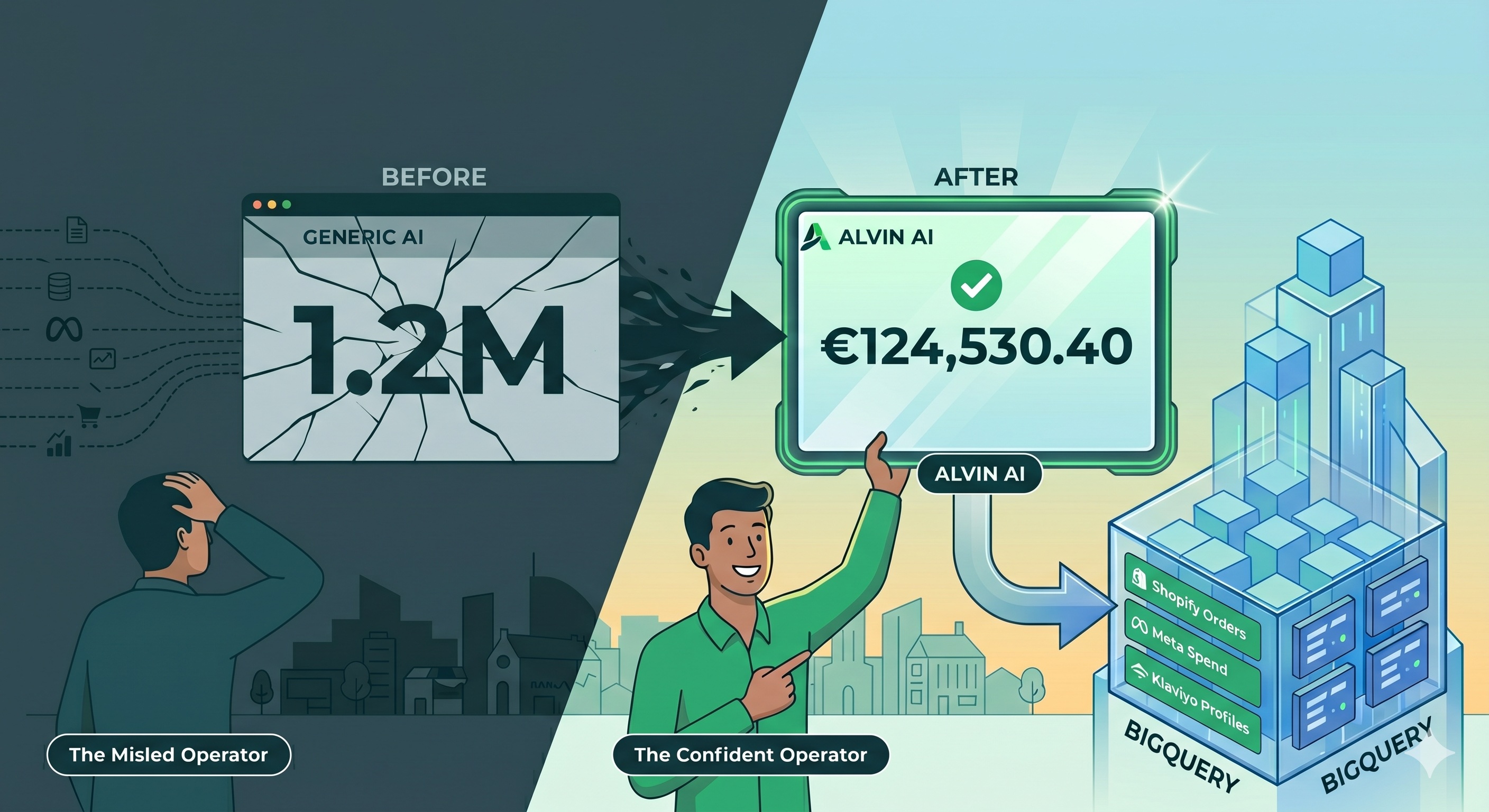
Alvin AI uses Google Gemini technology. Most generic AI tools guess answers based on patterns in training text. They hallucinate numbers when asked about complex financial metrics.
Alvin AI operates differently. It is hardcoded to execute actual SQL queries across your data repository in Google BigQuery before it provides an answer.
When you ask Alvin AI about your contribution margin, it does not estimate. It translates your natural language question into code. It runs that code against your first-party transaction data, server-side tracking logs, and actual ad spend records. It returns verified numbers. This architecture increases the reliability of your performance and profit reporting tenfold compared to standalone marketing software.
How Large Language Models Process Information
To maximize your results with Alvin AI, you must understand how Large Language Models operate. LLMs do not think like human data analysts. They calculate probabilities.
An LLM views text as a series of tokens. It predicts the most logical next word in a sequence based on vast datasets. When an LLM lacks specific parameters, it fills information gaps with generic web data. This causes inaccuracies in standard e-commerce software.
Alvin AI circumvents this limitation. It combines the linguistic fluency of an LLM with the computational precision of BigQuery. The LLM handles the conversation. BigQuery handles the math.
How to Work with AI for Valuable Outcomes
Working with advanced AI requires a shift in management style. Treat the AI agent as a highly capable, newly hired data analyst. This analyst possesses technical skills but lacks intimate knowledge of your specific business goals.
Do not use single-word commands. Provide guardrails. Direct the tool toward specific datasets, such as your Shopify order table or Meta ad spend logs. State your business definitions clearly, including how your brand calculates customer acquisition cost.
The Prompting Framework for Alvin AI
Use this structured approach to converse with Alvin AI. This framework ensures you receive actionable data instead of superficial summaries.
1. Give Alvin the right context
Establish the background before asking for numbers. Define your role, your business model, and your current objectives.
Good Context Example: I am the marketing operator of an e-commerce brand generating 25 million euros in annual revenue. We sell high-ticket home goods. Our current focus is reducing our customer acquisition cost during the summer slow season.
2. Be specific about what you want
Avoid broad questions like "How are our ads doing?" Define the exact metrics, timeframes, and comparison points you need.
Good Specificity Example: Calculate our new customer acquisition cost and our blended marketing efficiency ratio for the period between May 1st and May 25th 2026. Compare these numbers to the same period in 2025. Group the data by acquisition channel.
3. Ask for reasoning, not just answers
Instruct Alvin AI to show the steps it took to reach a conclusion. This allows you to audit the logic and understand the underlying drivers of your profit.
Good Reasoning Request Example: Provide the top three reasons why our contribution margin dropped last week. Show the exact breakdown of shipping costs and ad spend increases that led to this change.
4. Treat the first response as a draft
View your initial query as the start of a consultation. Use follow-up questions to refine the analysis and uncover deeper insights.
Good Follow-up Tactic: If Alvin AI shows that Meta ad efficiency decreased, follow up with: Filter that Meta data. Show me which specific campaigns experienced the highest cost-per-click increase. Identify if the issue lies in prospecting or retargeting.
5. Verify high-stakes data before taking action
Alvin AI minimizes errors by running direct BigQuery scripts. However, human operators must make the final strategic decisions. Before reallocating ad budget based on an AI insight, double-check the final numbers in your primary Performance Cockpit dashboard. Ensure your operational team aligns with the data.
Some examples of prompts that have helped teams drive more profitable growth
1. Channel performance overview + scaling decision
"Give me an overview of the channel performance over the past 2 months (March and April). Show per channel: revenue, advertising costs, gross profit, profit margin %, and ROAS. Sort the table by gross profit, from high to low. Mark channels where the profit margin has increased or decreased by more than 5 percentage points compared to the previous 2 months. Which channels are most interesting to scale further, and on which channels should we scale down?"
2. Advertising channel budget allocation
"Which advertising channel is currently driving the most revenue and profit: Meta Ads, Pinterest, or TikTok? Please analyze performance based on: Revenue, Profit, ROAS, CPA. Also answer: Which channel is scaling the fastest right now? Which channel should we prioritize to generate the quickest increase in revenue? Finally, give a clear recommendation on where to allocate more budget for maximum short-term growth."
3. Post-purchase drop-off analysis
"Analyze drop-off after the first purchase: what percentage of customers do not place a second order, within what time period, and which factors correlate with churn?"
4. Contribution margin vs. growth trade-off
"I want to increase contribution margin by 3% without losing growth pace, what should I do?"
5. Black Friday event deep-dive
"I want you to look at Black Friday sales of November 2025. There was a sales spike and a profitability spike. Based on your insights, I want you to analyze and give me the insights into the possible main drivers, causes, thresholds, etc. You can be creative if you want on how to analyze."
6. Returning vs. one-time customer behavior
"Analyze the behavior of returning vs. one-time customers: first order value, product mix, channel, time to second purchase, and repeat patterns."
7. ROAS year-over-year comparison
"Can you analyze ROAS of this year compared to last year?"
8. Subscription segment identification
"Which customer segments have the highest chance of subscription adoption and what are their characteristics?"
9. New vs. returning customer channel attribution
"Which campaigns or channels drive the best sales for new customers and which for returning customers in relation to CAC?"
10. Revenue underperformance with cost context (
"We notice that revenue is somewhat disappointing, but at the same time our Cost of Sale is also too high. The goal is to keep this at 11%. However, the end of May is the period when we expect the most revenue. Do you have any tips?"






Get all your e-commerce metrics together in one overview today.


